Maritime

SpaceKnow Guardian for maritime

SpaceKnow Guardian doesn’t just capture a moment — it monitors the same location over time, turning single images into patterns.

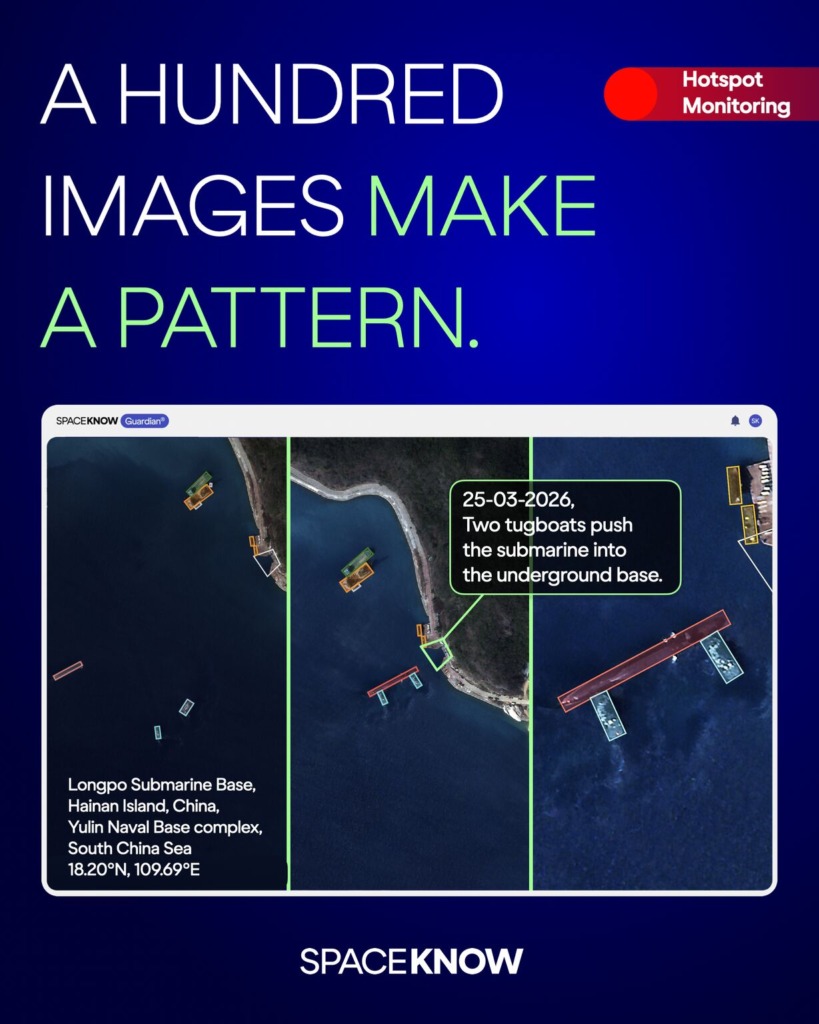
A submarine entering an underground base is one image. But when watched consistently — arrivals, departures, tugboat movements — a naval base begins to reveal how it actually operates.

Take Longpo Submarine Base in the South China Sea, one of China’s most strategically significant facilities. In this sequence from March 2026, two tugboats guide a submarine into dock — a routine event that, when tracked over months, reveals operational tempo, fleet readiness, and patterns of movement.

That’s the difference between an image and intelligence. Automated monitoring means the pattern builds continuously — with every image and every change, across any area of interest.
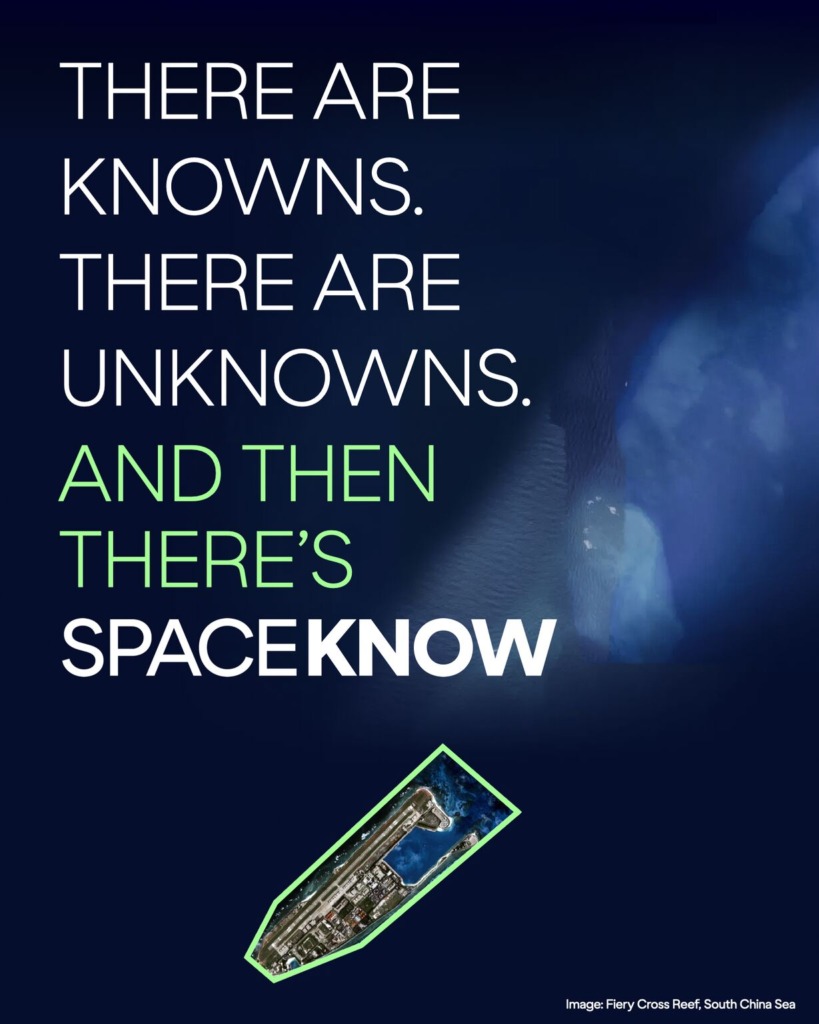
SpaceKnow Guardian turns unknown unknowns into intelligence you can act on.

It’s an old intelligence principle. There are things we know. There are things we know we don’t know. And then there are the things we don’t even know to look for.

In intelligence, that last category is where the risk lives.
A reef becomes a runway. A fishing fleet isn’t fishing. A vessel goes dark in contested waters. None of it announced. None of it reported. All of it visible — if you’re watching with the right sources.

Guardian processes imagery from multiple independent satellite providers — optical and SAR — and applies algorithms built to detect what changes, what moves, and what shouldn’t be there.

Because in this domain, what you don’t know to ask is the most dangerous question of all.

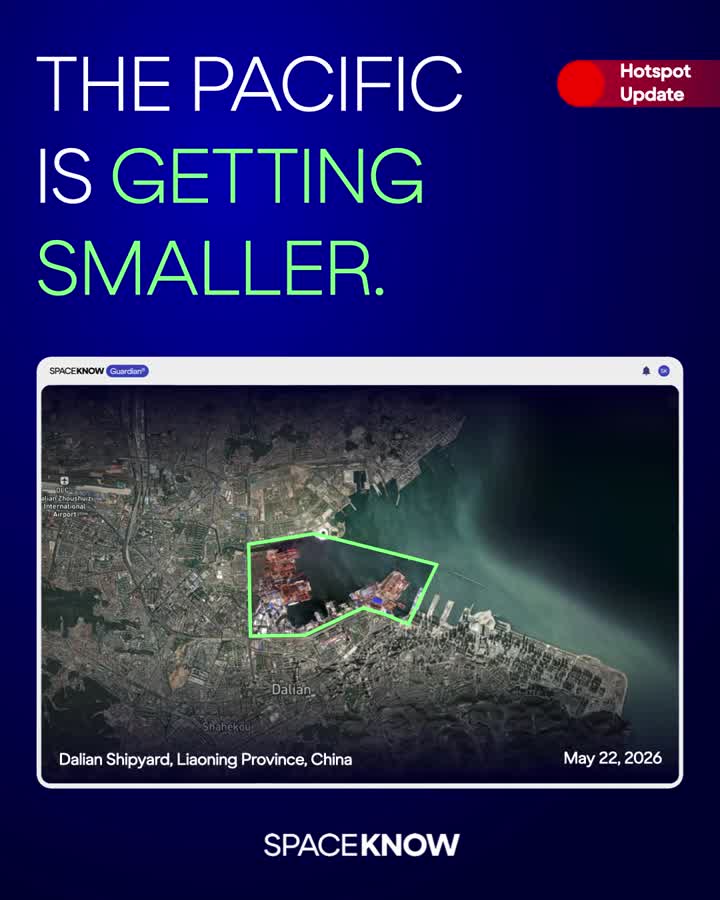
SpaceKnow Guardian has been tracking the construction of China’s Type 004 aircraft carrier at Dalian Shipyard since January 2025.

What satellite imagery shows — month by month:

January 2025 — Keel laying observed. September 2025 — Two large hull sections visible. Possible reactor containment structures identified — not seen in the construction of conventionally powered carriers Shandong or Fujian.

October 2025 — Hull sections merged. May 2026 — Hull approximately 296 meters long and 46 meters wide. Already larger than Fujian at the same stage.

Type 004 will most likely be China’s first nuclear-powered aircraft carrier. Nuclear propulsion eliminates refueling constraints — enabling sustained operations across the Pacific without port dependence. Estimated displacement: 110,000–120,000 tons. Estimated final length: 330–340 meters — comparable to the US Navy’s Gerald R. Ford class.

Today, only two countries operate nuclear-powered carriers: the United States (11) and France (1). Type 004 would make China the third.
For anyone monitoring Indo-Pacific maritime security, regional supply chains, or long-term infrastructure investment — the construction timeline is no longer speculative.
It is visible from orbit. And it is accelerating.

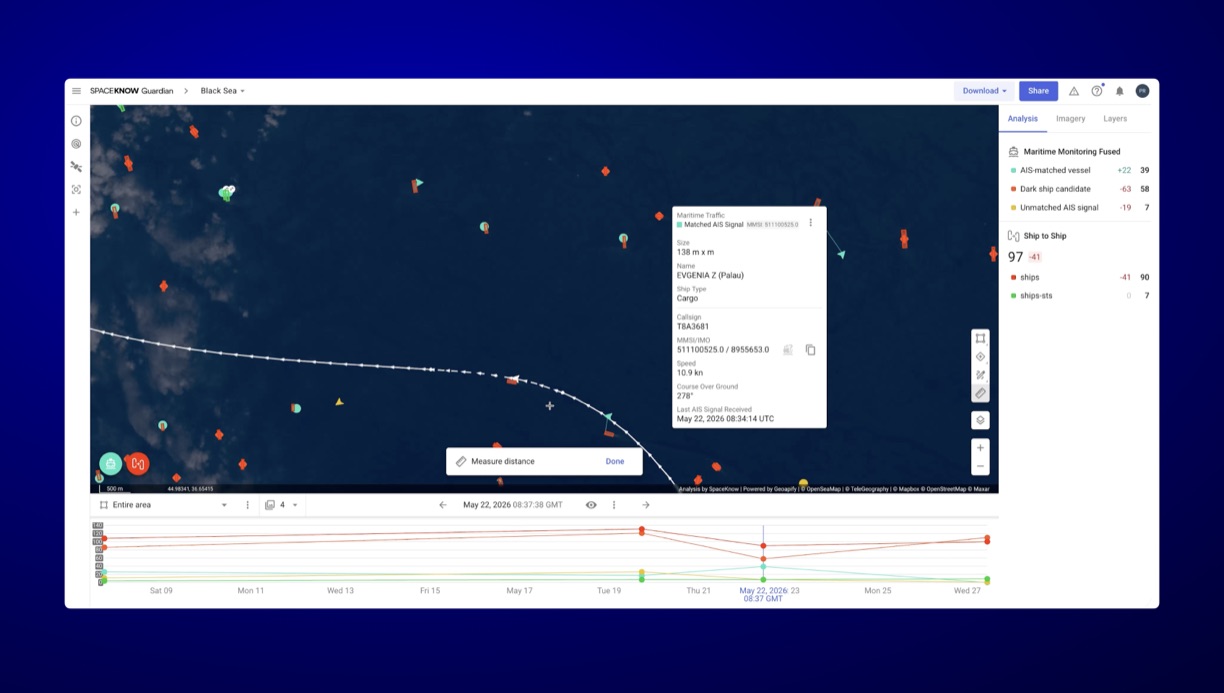
When AIS is jammed or spoofed, SpaceKnow Guardian shows you where ships actually are.
Multi-source satellite imagery — optical and SAR — from multiple independent providers. No single-point dependency.

In contested waters, navigation data can be jammed, spoofed, or switched off. Satellite imagery cannot.

Whether AIS is broadcasting, silent, or deliberately misleading, Guardian delivers continuous maritime domain awareness that doesn’t depend on a vessel’s transponder. If one provider’s coverage is degraded, others fill the gap.

For institutions responsible for MDA in contested environments — chokepoints, sanctioned vessel tracking, shadow fleet monitoring — this is the difference between situational awareness and operational certainty.
Analytical independence across any sensor, any provider, any orbit.
That’s what Guardian delivers.

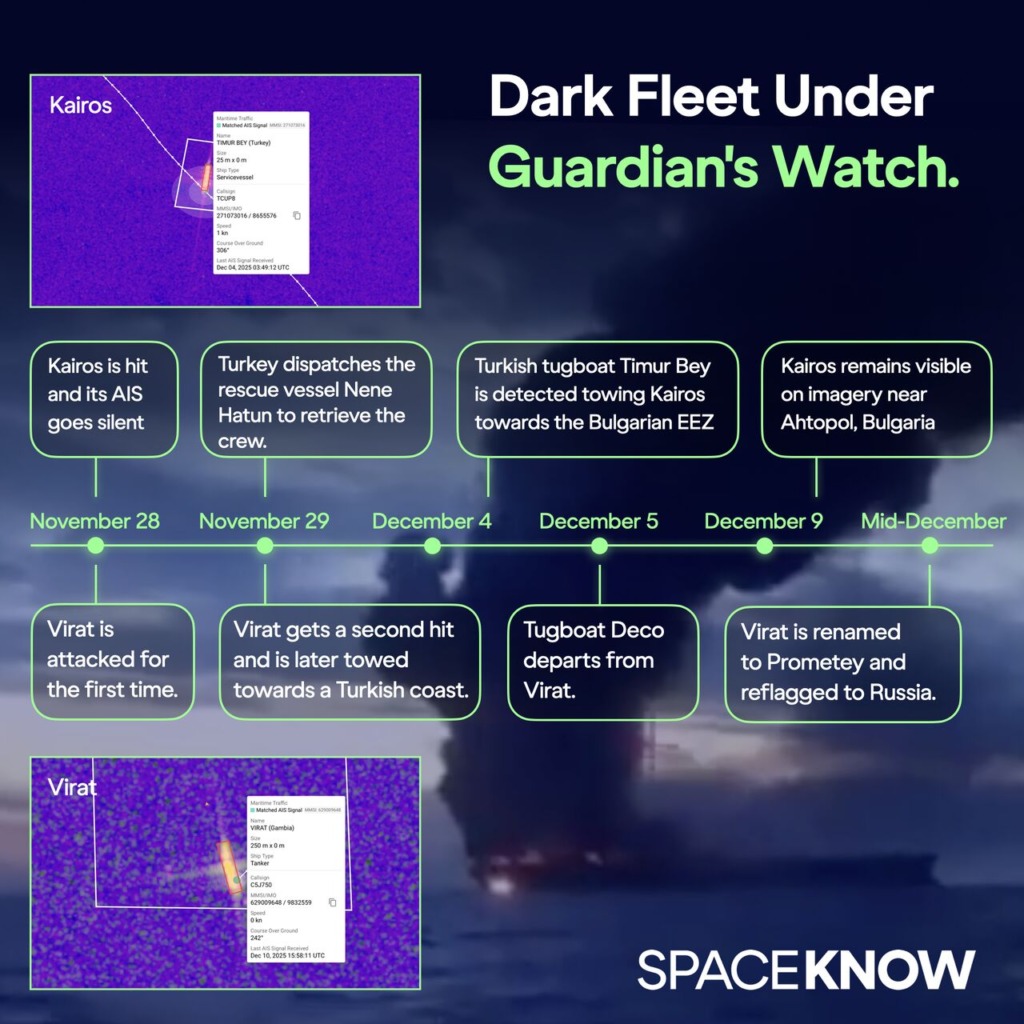
By the end of November 2025, two Gambia-flagged oil tankers, Kairos and Virat, were transiting the Black Sea. En route from Egypt to Novorossiysk, the two vessels operating as part of the Russian dark fleet were headed to load crude oil for export. Then the strike came. Ukrainian Sea Baby USVs hit both – and Kairos’ AIS went silent.
However, SpaceKnow Guardian does not take silence for an answer. Using satellite imagery, it continued to track both vessels monitoring their positions and assessing their likely courses. Neither tanker ever disappeared from view, so the Guardian was able to follow their whole story.

Interested in:

Please select at least one option